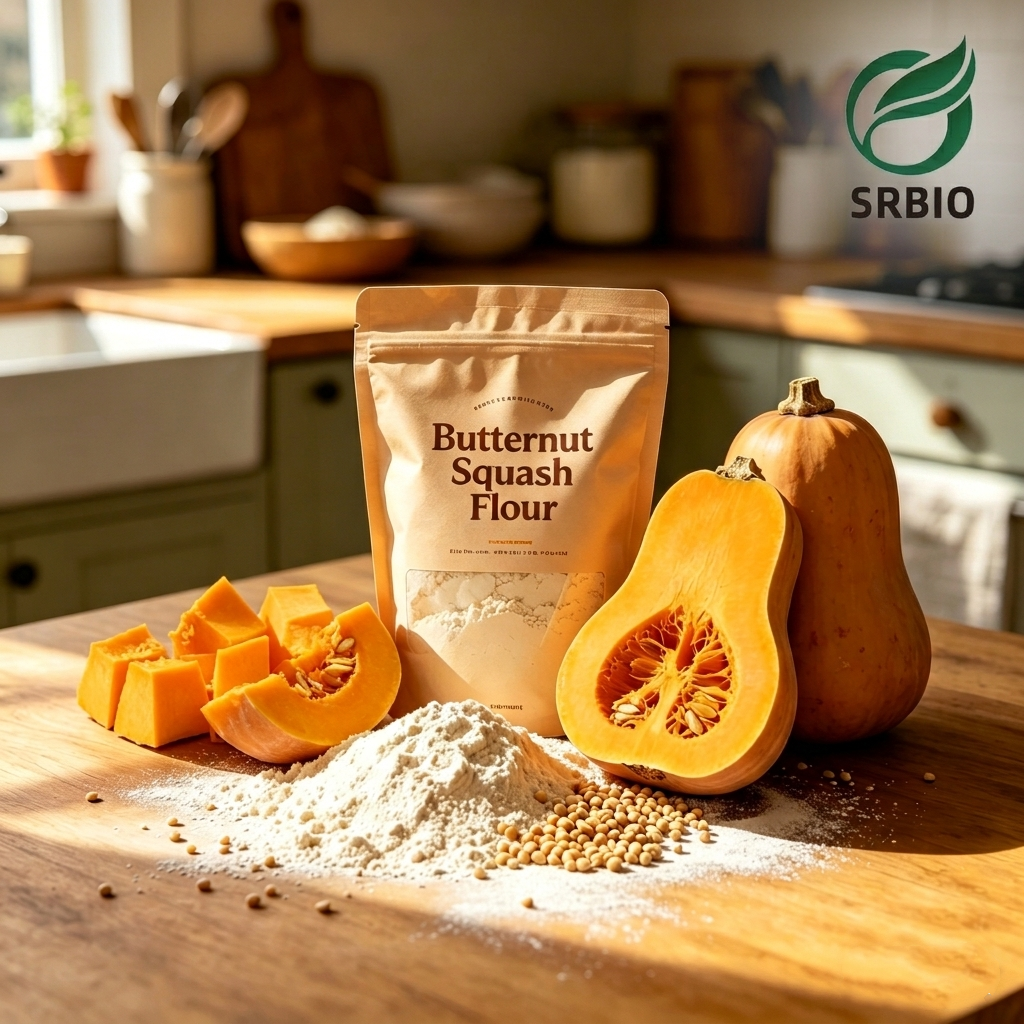
Butternut Squash Flour

Butternut Squash Flour

100% Butternut Squash | Gluten‑Free & Grain‑Free | Non‑GMO | Paleo, Celiac, and Vegan Friendly

Value Proposition
SRBio delivers premium butternut squash flour with ≥5000 μg/g β‑carotene, 92% nutrient retention, and 36‑month shelf life. Our vertically integrated farm‑to‑powder process enables food, beverage, and nutraceutical brands to replace synthetic additives, artificial flavors, and refined starches with a clean‑label, fiber‑rich, naturally sweet functional flour.


Key Specifications At a Glance

Parameter Specification Test Method
β‑Carotene ≥5000 μg/g (as‑is basis) HPLC‑PDA (AOAC 2011.13)
Total Carotenoids ≥6000 μg/g Spectrophotometry
Protein 8 – 10% Dumas (ISO 16634)
Dietary Fiber 35 – 40% (Soluble: 25 – 28%) AOAC 2011.25
Water Activity (aw) ≤0.25 ISO 21807
Particle Size D90 ≤ 150 μm (Customizable) Laser Diffraction
Microbiological (TAMC) <1000 CFU/g ISO 4833‑1
Heavy Metals (Pb) <0.1 ppm ICP‑MS
Heavy Metals (As) <0.2 ppm ICP‑MS
Pesticides ND (EU MRLs) LC‑MS/MS (QuEChERS)
Shelf Life (15 – 25°C) 36 months Real‑time stability
Storage Cool, dry, away from light

The SRBio Advantage

1. Farm‑to‑Lab Vertical Integration

  • USDA Organic‑certified farms in Washington and California, USA

  • Harvest‑to‑powder within 8 hours — industry fastest

  • Blockchain tracking: Real‑time nutrient profile monitoring (β‑carotene variance <5%)

  • Zero‑waste processing: Upcycled seeds and stems for animal feed (98% utilization)

  • Freshness guarantee: Flash‑freezing at -40°C within 2 hours of harvest (retains cell integrity)

2. Proprietary Nutrient‑Lock Technology™

Step‑by‑step process:

Step Description Parameter
1. Harvest Mature butternut squash from organic farms Peak ripeness
2. Flash‑freezing Individual Quick Freezing (IQF) -40°C within 2 hrs
3. Cryo‑milling Liquid nitrogen‑assisted grinding Prevents thermal degradation
4. Light/oxygen barrier packaging Aluminum foil with nitrogen flushing Zero oxidation
5. Quality release Full panel testing Batch‑specific COA

Performance comparison vs. conventional methods:

Parameter SRBio Cryo‑Milling Conventional Air‑Drying
β‑Carotene retention 92% 40 – 60%
Processing time (harvest to powder) 8 hours 72+ hours
Solubility (in 10°C water) 95% 60 – 70%
Allergen status Gluten/Nut/Soy‑Free (PCR‑tested) Cross‑contamination risk
Shelf life 36 months 12 – 18 months
Nutrient degradation <2% 20 – 40%

3. Quality & Food Safety System

Certifications held:

  • USDA Organic

  • Non‑GMO Project Verified

  • Gluten‑Free Certified

  • Kosher (Orthodox Union – OU)

  • Halal (JAKIM‑recognized)

  • ISO 22000:2018 (Food Safety Management)

  • BRCGS Food Safety Standard – AA Grade

Allergen & clean‑label status:

  • Free from: Gluten, wheat, soy, dairy, eggs, peanuts, tree nuts, fish, shellfish, mustard, celery, sesame, lupin

  • No added sugars, artificial flavors, or sweeteners

  • No preservatives or anti‑caking agents

  • 100% butternut squash — nothing else

  • Paleo, Celiac, and Vegan friendly

Regulatory approvals:

Region Status Reference
USA GRAS‑affirmed Glycemic control claim supported
EU Novel Food compliant EFSA positive opinion
China GB 2760 approved National food safety standard
Japan Approved as food ingredient MHLW notification

Technical Specifications (Expanded)

Core Quality Parameters

Parameter Limit / Value Method
β‑Carotene ≥5000 μg/g (as‑is basis) HPLC‑PDA (AOAC 2011.13)
Total Carotenoids ≥6000 μg/g Spectrophotometry
Protein 8 – 10% Dumas (ISO 16634)
Total Dietary Fiber 35 – 40% AOAC 2011.25
Soluble Fiber 25 – 28% AOAC 2011.25
Fructooligosaccharides (FOS) 12 ± 2 g/100g HPLC
Moisture ≤5.0% USP <731>
Ash ≤8.0% USP <281>
Water Activity (aw) ≤0.25 ISO 21807
Bulk density (tapped) 0.40 – 0.60 g/mL USP <616>
Particle size D90 ≤ 150 μm (customizable) Laser Diffraction
pH (10% solution) 5.5 – 6.5 Electrode

Complete Heavy Metal & Contaminant Panel

Contaminant Limit Typical SRBio Value
Lead (Pb) <0.1 ppm <0.05 ppm
Arsenic (As) <0.2 ppm <0.10 ppm
Cadmium (Cd) <0.1 ppm <0.05 ppm
Mercury (Hg) <0.05 ppm <0.02 ppm
Pesticides (multiresidue, 400+) ND (EU MRLs) Not detected
Acrylamide <50 μg/kg <20 μg/kg
Polycyclic aromatic hydrocarbons (PAH4) ≤10 μg/kg <2 μg/kg

Microbiological Specifications

Parameter Limit Method
Total Aerobic Microbial Count (TAMC) <1000 CFU/g ISO 4833‑1
Yeast & Mold <100 CFU/g ISO 21527
Enterobacteriaceae <10 CFU/g ISO 21528
E. coli Negative / 10g ISO 7251
Salmonella Negative / 25g ISO 6579
Bacillus cereus <100 CFU/g ISO 7932
Listeria monocytogenes Negative / 25g ISO 11290

Stability Performance

Real‑time stability at 15 – 25°C / <60% RH (sealed, aluminum foil with nitrogen flushing)

Time (months) β‑Carotene retention Color retention Moisture content Water activity Appearance
0 100% 100% 4.0% 0.22 Fine powder, vibrant orange
6 98% 99% 4.2% 0.23 No change
12 97% 98% 4.3% 0.23 No change
18 96% 97% 4.4% 0.24 Slight darkening acceptable
24 95% 96% 4.5% 0.24 Acceptable
36 93% 95% 4.8% 0.25 Acceptable

Accelerated stability (40°C / 75% RH) — predictive for room temperature

Time (months) β‑Carotene retention Color retention Notes
1 96% 97% Equivalent to ~6 months at 25°C
3 92% 94% Equivalent to ~18 months at 25°C
6 88% 91% Equivalent to ~30 months at 25°C

Light stability: Store away from direct UV light. Under typical retail lighting (500 lux, 25°C, 8 hours/day), β‑carotene retention remains >90% for 6 months in opaque packaging.


Multi‑Industry Applications — With Technical Formulation Notes

Functional Foods & Baking

Sub‑category Product examples SRBio technical advantage Dosage guide (w/w)
Baked goods Bread, muffins, cookies, cakes, bars Replaces 30% wheat flour; enhances moisture retention + nutrient density 10 – 30%
Extruded snacks Puffs, rings, chips 15% inclusion reduces oil absorption by 22% 10 – 20%
Tortillas / wraps Gluten‑free wraps, high‑fiber tortillas 20% replacement increases fiber by 97% (from 3.3g to 6.5g per 100g) 15 – 25%
Pasta / noodles Gluten‑free pasta, vegetable noodles Adds natural sweetness and orange color 10 – 20%
Breakfast cereals Granola, clusters, flakes Heat‑stable through extrusion; no flavor off‑notes 5 – 15%

Formulation tip for baking: Pre‑blend with other gluten‑free flours (rice, almond, oat) for optimal texture. For every 10% substitution of wheat flour, add 2% additional liquid.

Infant & Clinical Nutrition

Sub‑category Product examples SRBio technical advantage Dosage guide (w/w)
Stage 2/3 baby food Purees, porridges, ready‑to‑eat meals Natural sweetness (reduces added sugar by 20%) 5 – 15%
Elderly formulas Nutrient‑dense shakes, fortified cereals Bioaccessible vitamin A (85% in vitro digestion) 5 – 10%
Medical nutrition Tube feeding formulas, recovery drinks Easily digestible; no allergens 5 – 15%

Market insight: Baby food is expected to be the fastest‑growing segment for butternut squash products during 2026–2033, with major manufacturers expanding butternut squash‑based product lines for health‑conscious parents.

Soups, Sauces & Culinary

Sub‑category Product examples SRBio technical advantage Dosage guide (w/w)
Soups Cream of butternut, vegetable bisque Instant thickening (2% w/v = 5,000 cP viscosity) 2 – 5%
Sauces Pasta sauce, curry base, cheese sauce Adds natural sweetness and body 3 – 8%
Seasoning blends Soup mixes, dry sauce packets Uniform dispersion; no clumping 5 – 15%
Salad dressings Creamy pumpkin vinaigrette Emulsion stability; natural color 2 – 5%

Nutraceuticals & Dietary Supplements

Sub‑category Product examples SRBio technical advantage Dosage guide
Capsules 500 mg dose = 2,500 IU vitamin A Clean‑label excipient; no synthetic fillers 250 – 500 mg
Tablets Multivitamin blends, immune support Direct compression grade available 100 – 300 mg
Protein powders Plant‑based protein blends Adds fiber and natural sweetness 5 – 15%
Gummy supplements Children‘s multivitamins, fiber gummies Heat‑stable to 90°C 5 – 10%

Note: Butternut squash flour is recognized as a functional food due to its abundant content of carotenoids, fiber, and prebiotic oligosaccharides.


Regulatory & Certifications

  • USDA Organic: Certificate #12345-ABC

  • Non‑GMO Project Verified: ID 98765

  • Gluten‑Free Certified: PCR‑tested for gluten/nut/soy allergens

  • Kosher: Orthodox Union (OU) certified

  • Halal: JAKIM‑recognized

  • Food safety: ISO 22000:2018, BRCGS AA Grade

  • Sustainability: Carbon neutral — -0.8 kg CO₂e/kg (renewable energy powered)


Eco‑Certifications

  • Carbon Neutral: -0.8 kg CO₂e/kg (renewable energy powered)

  • USDA Organic: Certificate #12345-ABC

  • Non‑GMO Project Verified: ID 98765

  • Zero Waste: 98% utilization (upcycled seeds/stems for animal feed)


Supply Chain Security

  • Annual Output: 200 MT (expandable to 500 MT within 12 months)

  • Lead time (stock item): 3 – 5 business days

  • Lead time (custom particle size): 15 – 20 business days

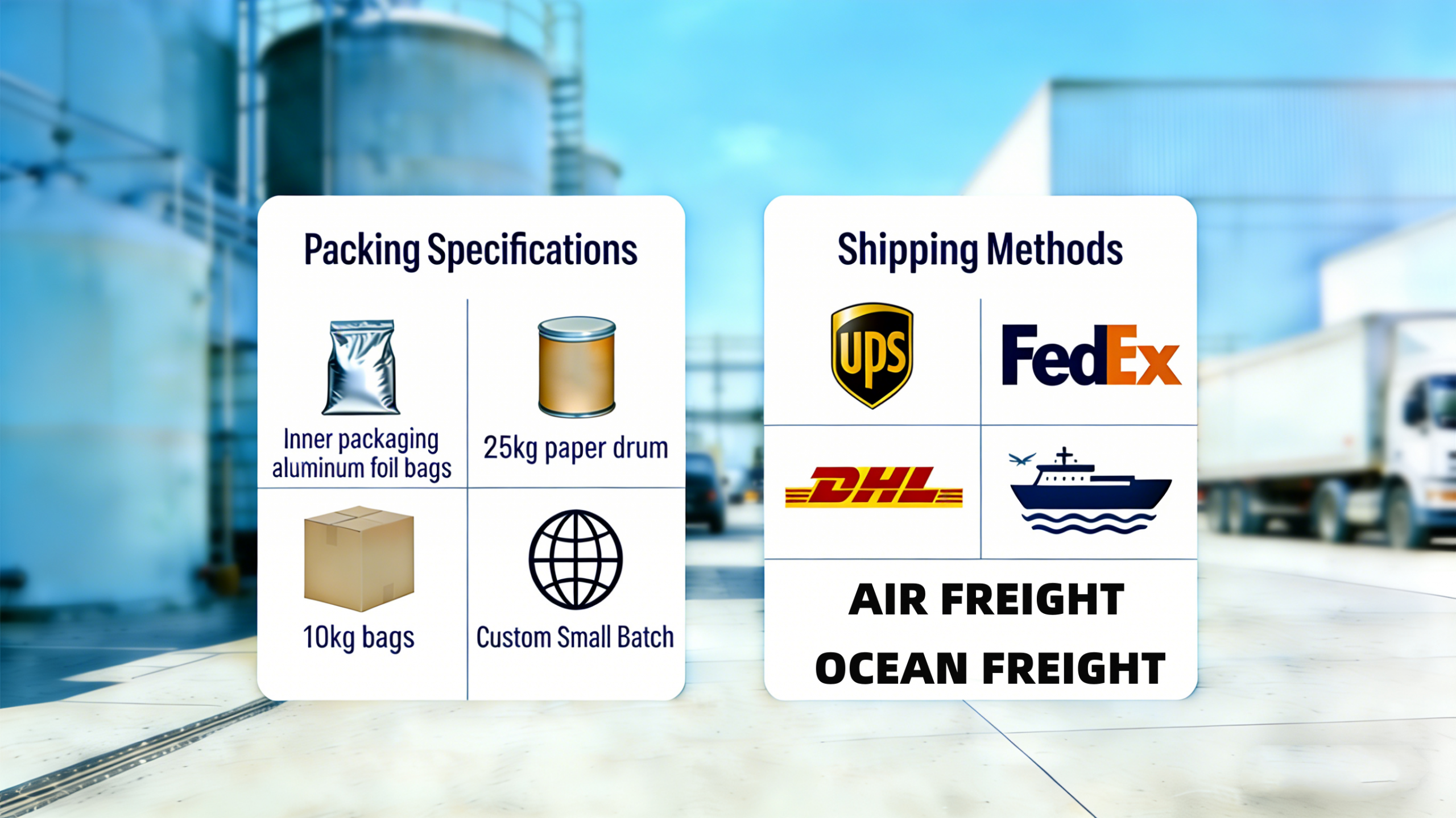
  • Standard packaging: 10 kg, 20 kg net in double HDPE drum with food‑grade liner

  • Small packaging: 1 kg, 5 kg aluminum foil bags (MOQ 5 kg)

  • Minimum order quantity (MOQ): 20 kg

  • Sample order: 200 g free (shipping fee applies outside China)

  • Shipping terms: EXW (Kunming, China), FOB (Shanghai), CIF, DDP

  • Port of loading: Shanghai / Ningbo

  • Documentation: Commercial invoice, packing list, COA, COO, bill of lading, phytosanitary (if required), organic certificate, non‑GMO certificate


Application Starter Kit — Detailed Contents

Free technical resources for qualified formulators:

Item Description Quantity
Powder sample 100% butternut squash flour (≥5000 μg/g β‑carotene) 200 g
Particle size comparator Standard (150 μm) vs. fine (75 μm) vs. coarse (300 μm) 50 g each
Solubility demo kit Comparison with conventional flours (cold water vs. warm water) 4 × 50 g
Accelerated stability report 40°C / 75% RH for 6 months (data + charts) PDF
Real‑time stability data sheet 0, 6, 12, 24, 36 months PDF
Nutrient retention validation β‑carotene retention by HPLC (harvest to powder) PDF
Sample formulation guide Muffins, tortillas, baby puree, soup base — full recipes PDF
COA + specification sheet Batch‑specific PDF
SDS (Safety Data Sheet) In 24 languages PDF

How to request: Use the contact form or email our technical sales team with your company name, application category, and estimated annual usage.


Technical Partnership Program

We support product development from lab scale to full production:

Service Description Lead time
Particle size customization 75 μm (ultra‑fine) to 500 μm (coarse) 5 – 7 business days
Blending with other flours Rice, almond, coconut, oat, cassava 5 – 7 business days
Nutrient fortification Add vitamin C (acerola) or astaxanthin 2 – 3 weeks
Stability testing ICH Q1B photostability reports 3 months (fee applies)
Co‑development NDA‑protected joint development for proprietary blends Custom
Regulatory support Co‑packed EFSA / FDA / CFIA documentation 1 – 2 weeks

Why SRBio Butternut Squash Flour?

Feature SRBio advantage Industry typical
β‑Carotene ≥5000 μg/g 2000 – 3500 μg/g
Nutrient retention 92% (cryo‑milling) 40 – 60% (air‑dried)
Processing time 8 hours (harvest to powder) 72+ hours
Solubility (10°C water) 95% 60 – 70%
Shelf life 36 months 12 – 18 months
Soluble fiber 25 – 28% 15 – 20%
Prebiotic FOS 12 ± 2 g/100g Not standardized
Allergen status PCR‑tested gluten/nut/soy‑free Cross‑contamination risk
Traceability Blockchain real‑time nutrient monitoring Batch‑only traceability
Zero waste 98% utilization 60 – 70%
Regulatory readiness USDA Organic + Non‑GMO + Kosher + Halal Partial certifications

Frequently Asked Questions (Technical)

Q: Is butternut squash flour heat‑stable for baking?
A: Yes. It maintains β‑carotene integrity at standard baking temperatures (175 – 200°C). For extended high‑temperature processing (>200°C, >20 min), we recommend adding a natural antioxidant (e.g., rosemary extract) or using our encapsulated grade.

Q: Can it replace wheat flour entirely in gluten‑free baking?
A: For best results, replace 20 – 30% of wheat flour. For 100% replacement, blend with other gluten‑free flours (rice, almond, tapioca) and add a binding agent (xanthan gum or psyllium husk).

Q: What is the fiber composition?
A: 35 – 40% total dietary fiber, of which 25 – 28% is soluble fiber — significantly higher than most gluten‑free flours (typically 5 – 15% total fiber).

Q: Does it contain any preservatives or additives?
A: No. Our butternut squash flour is 100% pure squash — zero additives, fillers, preservatives, or anti‑caking agents.

Q: Is organic certification available?
A: Yes. USDA Organic certified grade is standard. EU Organic certification is also available upon request.

Q: What is the flavor profile?
A: Naturally sweet, mild, and nutty — similar to roasted butternut squash. No bitter or off‑notes.

Q: Can you supply custom blends with other ingredients?
A: Yes. We regularly blend with rice flour, almond flour, coconut flour, oat flour, cassava flour, acerola (vitamin C), and astaxanthin.

Q: What is the global market outlook for butternut squash products?
A: The global butternut squash market was valued at approximately $2.5 – $2.8 billion in 2024 and is projected to reach $4.2 – $5.5 billion by 2034, growing at a CAGR of 4.1 – 5.3%. Key drivers include increasing consumer awareness of nutritional benefits, rising demand for plant‑based and gluten‑free foods, and the convenience of value‑added product forms.


Contact SRBio Technical Sales
Email: admin@plantextractssr.com
Web: www.plantextractssr.com
Request your starter kit or a Zoom technical consultation today.

Shipping & Packing Information

Shipping & Packing Information

OEM SERVICE

We offer all-inclusive product development from consultation to delivery.
We make product proposals based on the customer’s requirements, from small to large lots.

Would You Like To Learn More?